Industrialized retrofit: the largest hidden infrastructure market in Europe.
Why energy retrofit at scale will not be a building market, but an industrial infrastructure market. And why almost no investor sees it yet.
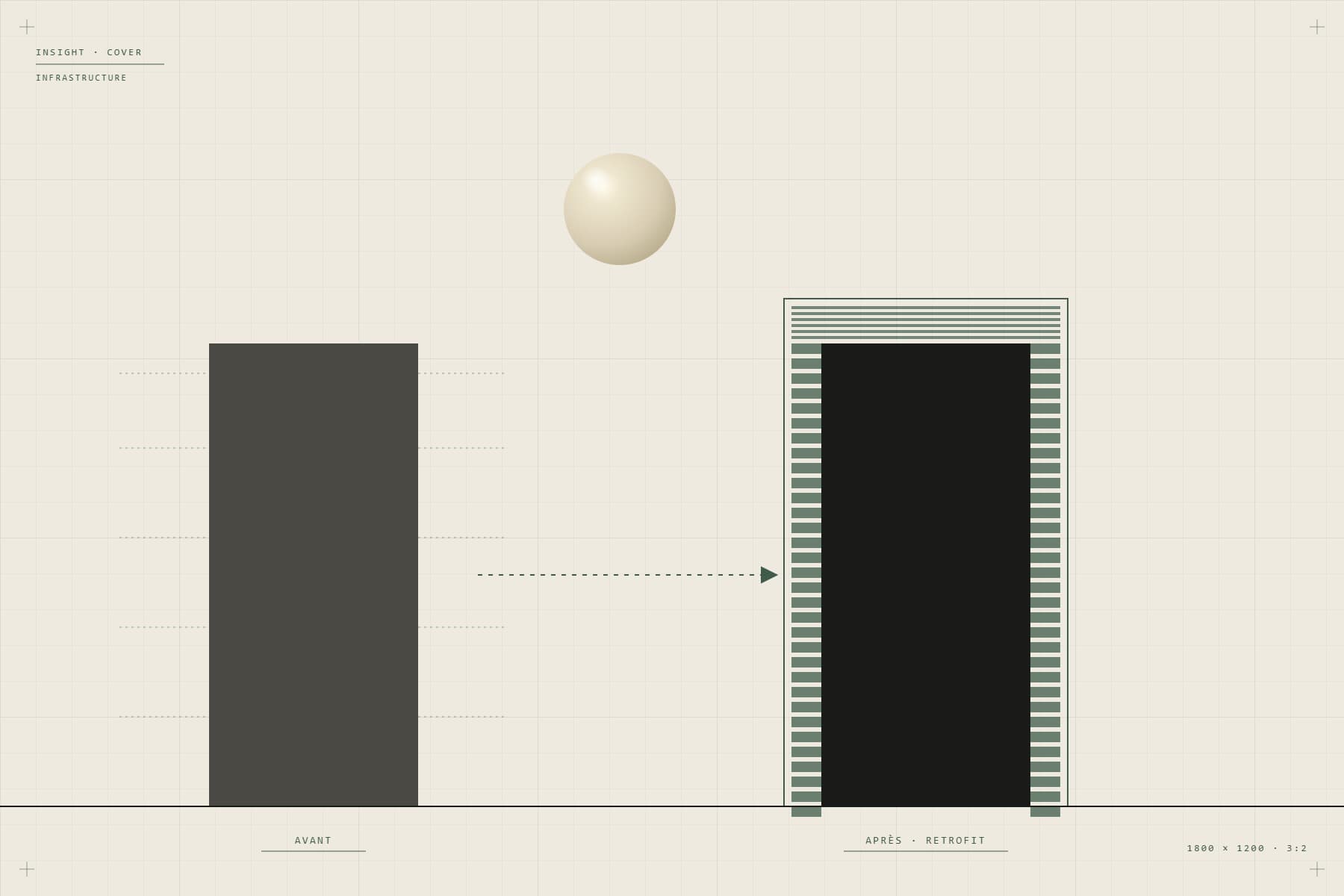
Energy retrofit of the European building stock is publicly framed as a building problem: insulation, windows, heat pumps, subsidies. That reading is partially correct but structurally insufficient. The true nature of retrofit at European scale (250 million dwellings, binding regulatory targets, finite public budgets) is that of an industrial infrastructure market, closer to mobility or energy than to traditional construction.
The difference is structural. A building market runs on long cycles, artisanal margins, and an extreme fragmentation of operators. An infrastructure market runs on industrialized cycles, contractual margins, and consolidation around specialized operators. The boundary between the two models is moving, and within that movement a first-rank venture opportunity is forming.
What is changing, structurally
Three forces combine. First: regulation. The Energy Performance of Buildings Directive (EPBD) sets performance thresholds whose enforcement demands an intervention cadence that artisanal supply cannot sustain. Second: capital. Infrastructure funds, long absent from existing stock, are beginning to structure vehicles dedicated to retrofit, with ticket sizes and return horizons that reshape the economic nature of the market. Third: technology. Façade prefabrication, digital twins, light robotics, AI for site orchestration. The value chain is digitizing faster than public perception registers.
The capture window is narrow. The actors who industrialize European retrofit are being formed now. Or they will not be formed.
Where defensibility sits
Three zones of defensibility emerge. First, industrial defensibility: prefabrication capacity, production sites, vertical integration. Second, data defensibility: who owns the audit databases, calibrated thermal models, instrumented site flows. Third, network defensibility: who contracts with social landlords, organized condominiums, public operators. The three zones reinforce one another.
A prediction
Within 18 months, we expect two to three European industrialized-retrofit operators to reach valuations above €500m, and at least one dedicated infrastructure fund to close above €1bn. If that prediction holds, the market will have formed its first structuring tier. If it does not, regulatory or capital friction will have been underestimated. In which case the thesis needs recalibration, not abandonment.